
They Knew Something They Shouldn’t Have
Let me ask you something.
Does it feel odd that school barely mentions the Sumerians?
History classes rush past them, even though these people laid down the basic framework of civilization. Writing began with them. Cities took shape through them. Laws, calendars, and systems of measurement came from their world. Time itself still follows rules they set thousands of years ago.
Yet most people never hear about them unless they go searching.
Once you start searching, the story changes fast.
Because what the Sumerians knew doesn’t line up with what we expect from a society that ancient.
The knowledge that built our modern world
Five thousand years ago, the Sumerians already tracked the Moon with care and consistency. They followed its phases, recorded its cycles, and built lunar calendars that guided agriculture and ritual. At the same time, they used a base-60 number system that still shapes how we count hours, minutes, and seconds.
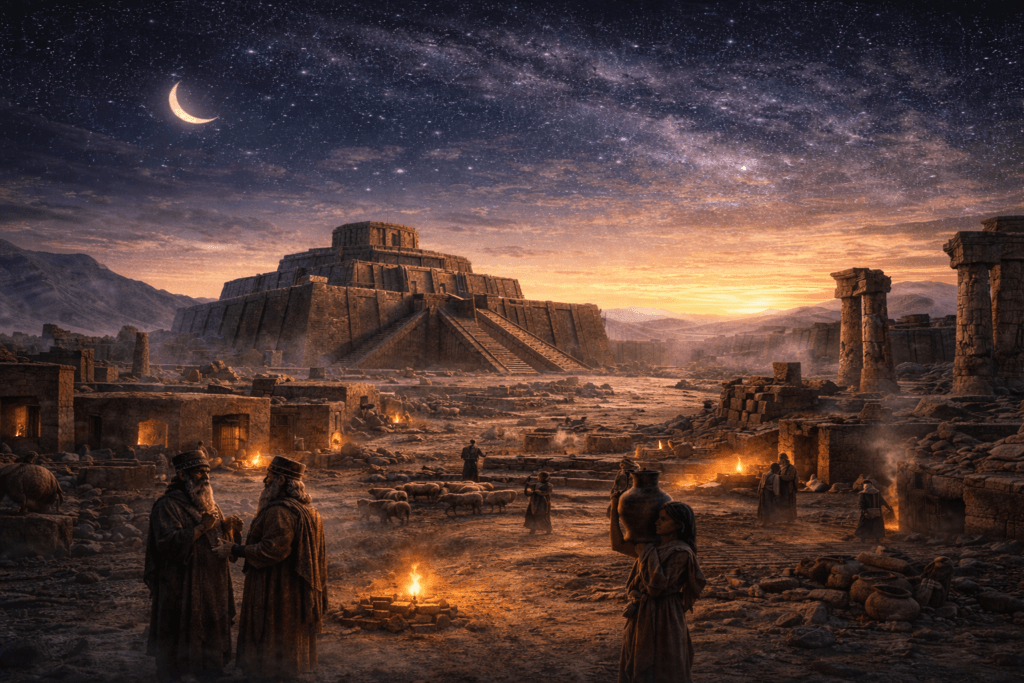
That system didn’t emerge randomly. Instead, it required observation, repetition, and long-term record keeping.
Beyond the Moon, Sumerian scholars divided the sky into constellations and followed the movements of planets across them. They noticed when planets slowed, stopped, and appeared to reverse direction. Today we call that retrograde motion. Back then, they simply recorded it.
Even without telescopes, they tracked patterns that demand patience and precision.
One artifact proves this better than any story.
The Venus Tablet of Ammisaduqa records the 584-day cycle of Venus in striking detail. The tablet lists appearances, disappearances, and repeating intervals across decades. Modern astronomers still consult those records because the data holds up.
In other words, these weren’t myths dressed up as science. These were observations carved into clay.
Just as important, temples doubled as observatories. Priests studied the sky as part of their sacred duty. Knowledge, religion, and governance formed a single system rather than separate fields.
That alone should place the Sumerians at the center of ancient history.
However, the strangest evidence comes from a much smaller object.
The artifact that raises uncomfortable questions
Among the many objects found in Mesopotamia, one cylinder seal stands apart. Known as VA 243, it shows a large central figure surrounded by eleven smaller circles.
Altogether, twelve bodies appear in the image.
Some scholars describe the scene as symbolic. Others suggest it represents a star with attendants. Still, many observers notice something else entirely. The layout closely resembles a solar system diagram.
That interpretation immediately creates a problem.
Several planets shown in such a system remain invisible to the naked eye. Uranus and Neptune require telescopes. Pluto demands modern instruments. Ancient observers shouldn’t have known they existed.
So what does the seal actually depict?
A coincidence struggles to explain the structure. A purely decorative symbol fails to explain the precision. The image feels intentional, even if its meaning remains uncertain.
As a result, VA 243 refuses to stay quietly filed away.
Nibiru and the problem of interpretation
At this point, another name enters the conversation: Nibiru.
The word appears in multiple Babylonian and Sumerian texts, most notably in the Enuma Elish. In those writings, Nibiru functions as a “crossing place” or transition point in the sky.
Sometimes the texts associate it with Jupiter. Other passages suggest something less stable and less defined. Because the descriptions vary, scholars continue to debate its meaning.
In the twentieth century, writer Zecharia Sitchin pushed the idea much further. He claimed Nibiru represented a twelfth planet with a long orbit. According to his theory, beings known as the Anunnaki came from that world and interacted with early humans.
Most academics reject those conclusions. They criticize his translations and methodology.
Even so, one fact remains. Nibiru itself isn’t a modern invention. The word exists in ancient texts, and its definition never fully settles.
The mystery comes from inconsistency, not imagination.
Gods who descended, not emerged
According to Sumerian belief, the gods didn’t evolve on Earth. Instead, they arrived from the sky.

The Anunnaki came down from above and brought knowledge with them. They taught mathematics, established laws, and guided architecture. Civilization didn’t grow upward on its own. It arrived with help.
That belief shaped how the Sumerians built.
Ziggurats towered over cities, not just as temples but as symbolic bridges between Earth and the heavens. Builders aligned them with solstices, lunar events, and specific stars. The sky dictated design.
If the stories only served as metaphors, those alignments wouldn’t matter. Yet they appear again and again.
Clearly, the heavens held practical importance, not just spiritual meaning.
A civilization with an ancient memory
The Sumerian King List complicates things even more. It describes rulers who reigned for tens of thousands of years before a great flood destroyed the world.
Modern readers often treat those reigns as symbolic. That explanation makes sense on the surface. Still, symbols usually point toward something deeper.
Flood stories appear across the globe. Cultures with no contact share similar memories of catastrophe. The Sumerians didn’t invent that idea in isolation.
Archaeology now supports this wider picture.
Göbekli Tepe, dated to more than twelve thousand years ago, shows that humans built monumental, sky-aligned structures long before cities or agriculture. Its builders understood symbolism, astronomy, and ritual at a surprisingly early stage.
Meanwhile, other cultures preserved star knowledge of their own. Egypt tracked stellar cycles. The Maya mapped planetary motion. Vedic traditions described cosmic rhythms. Knowledge didn’t rise once and vanish. Instead, it resurfaced repeatedly.
That pattern suggests inheritance rather than invention.
The question that remains
At this stage, one question refuses to go away.
Where did the Sumerians get their knowledge?
They didn’t behave like beginners. They acted like inheritors. They recorded systems already refined. They preserved information rather than stumbling toward it.
Possibly, they inherited fragments from a civilization lost at the end of the last Ice Age. Perhaps oral traditions carried scientific memory forward. Or maybe myth preserved real events that later generations struggled to explain.
No single answer solves every piece.
Still, dismissing the question solves nothing.
The last echo
Maybe the Sumerians weren’t the beginning of civilization.
Instead, they may have stood at the end of a much longer story.
They gathered fragments, carved them into clay, and aligned stone with stars. Over time, meaning faded, but structure remained.
Something echoes through their work.
They knew something.
Something they shouldn’t have.