
Twelve thousand years ago, long before the pyramids or Stonehenge, someone carved a story into stone.
A vulture with wings outstretched.
A scorpion ready to strike.
And a man, headless, lifeless, staring into eternity.
Then, they buried it.
Carefully. Intentionally. As if hiding a secret meant for the distant future.
That carving sits on what’s now called Pillar 43, or The Vulture Stone, at Göbekli Tepe, the world’s oldest known temple. And some researchers believe it might not just be a monument to the past… but a message to the future.
A warning.
The Enigma of Pillar 43
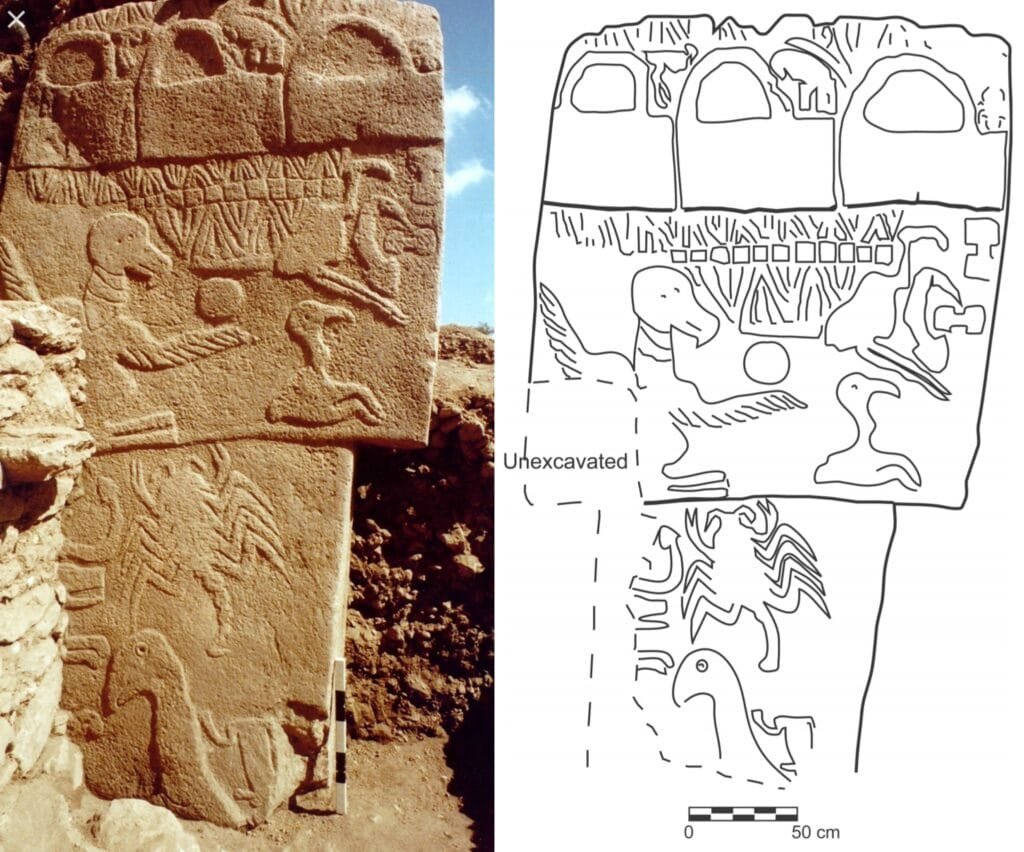
Pillar 43 stands in Enclosure D, the oldest and most monumental circle at Göbekli Tepe, in southeastern Turkey. Each of these limestone circles once held towering T-shaped pillars, carved with animals and strange symbols.
On Pillar 43, the carvings are unusually complex: a vulture raising a wing toward a round disk, a scorpion sprawling beneath, a human body missing its head, and a series of “H”-shaped glyphs scattered above. Near the top, three curious shapes, like little handbags or shrines, hover in a row.
Archaeologists still debate what these images mean. Some see a funerary scene — vultures delivering souls to the heavens. Others believe it’s a cosmic diagram, a kind of celestial chart connecting sky, death, and rebirth.
But the question that refuses to die is why.
Why carve this, and why bury it?
The Sky and the Dead on Pillar 43
Göbekli Tepe was built around 9600 BC, at the very dawn of civilization, before writing, farming, or the wheel. So when researchers noticed the carvings might mirror constellations, it caused a stir.
A 2017 study from the University of Edinburgh suggested that the animals on Pillar 43 could map to real constellations visible around 10,950 BC, the same period when Earth was struck by a catastrophic cooling event called the Younger Dryas.
Some scientists think this cold snap was triggered by a comet impact, fragments from the Taurid meteor stream striking the ice sheets and releasing floods that reshaped the planet.
If that theory is right, then the people of Göbekli Tepe may have witnessed the aftershocks of an extinction-level event, and carved it into stone.
Even the world’s oldest flood stories seem to echo this moment.
The Sumerians called it the Flood of Ziusudra.
The Bible remembers it as Noah’s Ark.
The Epic of Gilgamesh tells of a man warned by the gods before the waters rose.
Maybe those myths are cultural echoes of a real cataclysm.
And maybe the Vulture Stone is the oldest surviving eyewitness account, a survivor’s message, not a legend.
Buried on Purpose
Most ancient monuments collapse or erode over time. Göbekli Tepe didn’t. It was buried.
The people who built it filled its enclosures with rubble, tools, and thousands of animal bones, layer upon layer, sealing the site like a time capsule.
This wasn’t accidental. It took enormous effort. Hundreds of tons of material were moved by hand to entomb the very structures they’d once worshipped in.
Why would anyone do that?
When you want something forgotten, you destroy it.
When you want something remembered, you bury it.
Maybe the builders of Göbekli Tepe didn’t want their message erased, they wanted it protected.
The Skull Cult
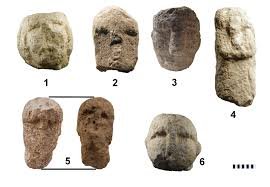
Among the fill, archaeologists found human skull fragments, some drilled, others carved with deep grooves.
These weren’t trophies of war or random burials. They were ritual objects, deliberately altered, perhaps even displayed.
To the people of Göbekli Tepe, the skull may have been sacred, the container of the spirit, the seat of memory.
So what does it mean when a culture starts carving the dead?
It means they’re trying to hold on to something, to the knowledge, to the experience, maybe even to the fear of what they lived through.
That’s not worship.
That’s remembrance.
The Four Clues
Let’s pull the pieces together, the strongest evidence Göbekli Tepe was a warning.
First, the imagery:
A headless man, a scorpion, a vulture reaching toward a disk. Death and danger carved side by side, not myth, but memory.
Second, the sky pattern:
Those same animals align with constellations from 10,950 BC, the very date of the Younger Dryas disaster. It’s as if the sky itself was used as a timestamp, preserving the moment catastrophe struck.
Third, the burial:
This wasn’t superstition; it was strategy. The site was sealed to survive. When you want your story to outlast everything, fire, flood, or time, you bury it.
And fourth, the skulls:
Modified, carved, displayed. Not trophies, transmitters.
Symbols of remembrance, ritualized into eternity.
Taken together, these aren’t random coincidences.
They form a pattern, a culture that experienced something world-ending, and turned trauma into art, art into ritual, and ritual into a message for whoever would find it next.
The Three Bags on Pillar 43
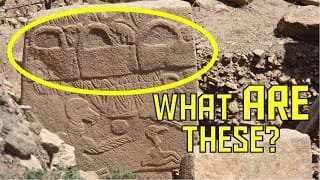
Now, look again at the top of Pillar 43. Those three shapes, the ones that look like little handbags, might be the strangest detail of all.
You’ll find the same “handbag” symbol carved thousands of years later in Sumer, Assyria, and even Mesoamerica. Always in the hands of gods, sages, or beings bringing knowledge from the heavens.
How does the same symbol appear across cultures separated by oceans and millennia?
Maybe it began here at Göbekli Tepe.
Maybe those three “bags” represent the transfer of knowledge itself, the tools or gifts the survivors wanted to pass forward.
Three bags.
Three enclosures.
Three messages from a vanished world, sealed beneath the soil for twelve thousand years.
So… Was Pillar 43 a Warning?
When you line up all the clues, the death imagery, the cosmic code, the deliberate burial, the carved skulls, and those three mysterious bags, Göbekli Tepe starts to look less like a temple and more like a monument of memory.
A record carved by survivors.
A civilization saying: “We saw what came from the sky. Don’t let it happen again.”
Maybe that’s what they buried, not fear, but knowledge.
Not myth, but memory.
And twelve thousand years later, we’re the ones standing above their buried world… finally trying to read what they left behind.
What do you think Pillar 43 is really saying? A myth? A map? Or a warning meant for us?
Join the conversation
For more posts click forgotten history
or why not join the conversation on X at @4gottnHistory
or finally why not watch our videos on YouTube