
How Old Is the Sphinx? well, geological evidence suggests the Great Sphinx of Giza may be far older than we think,and its true age might rewrite everything we know about early civilization.
How Old Is the Sphinx?
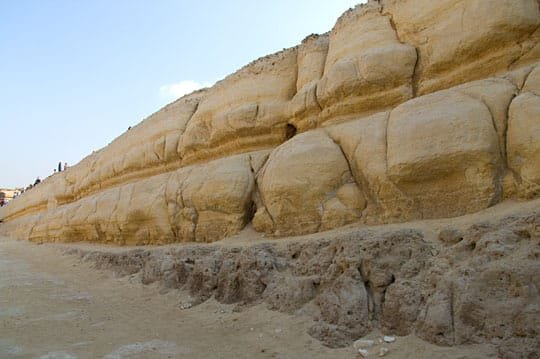
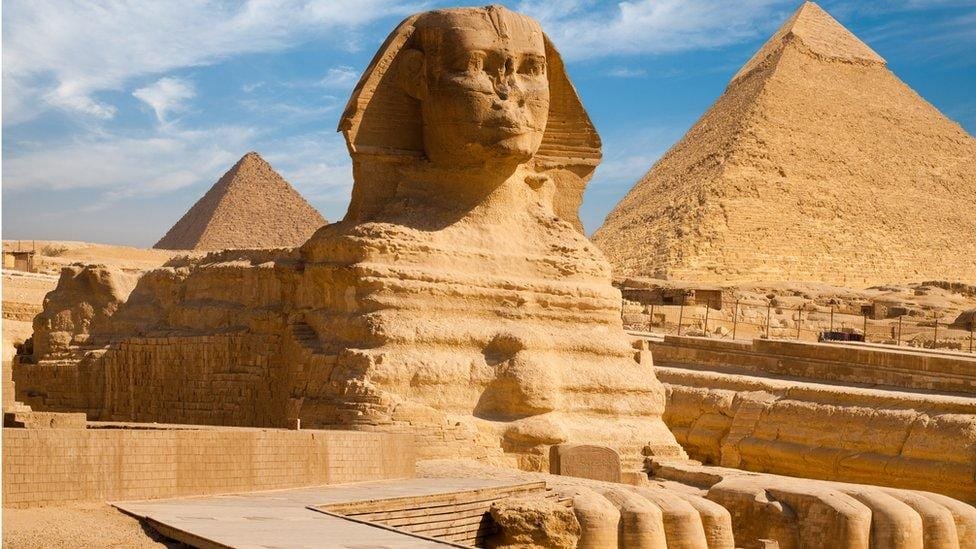
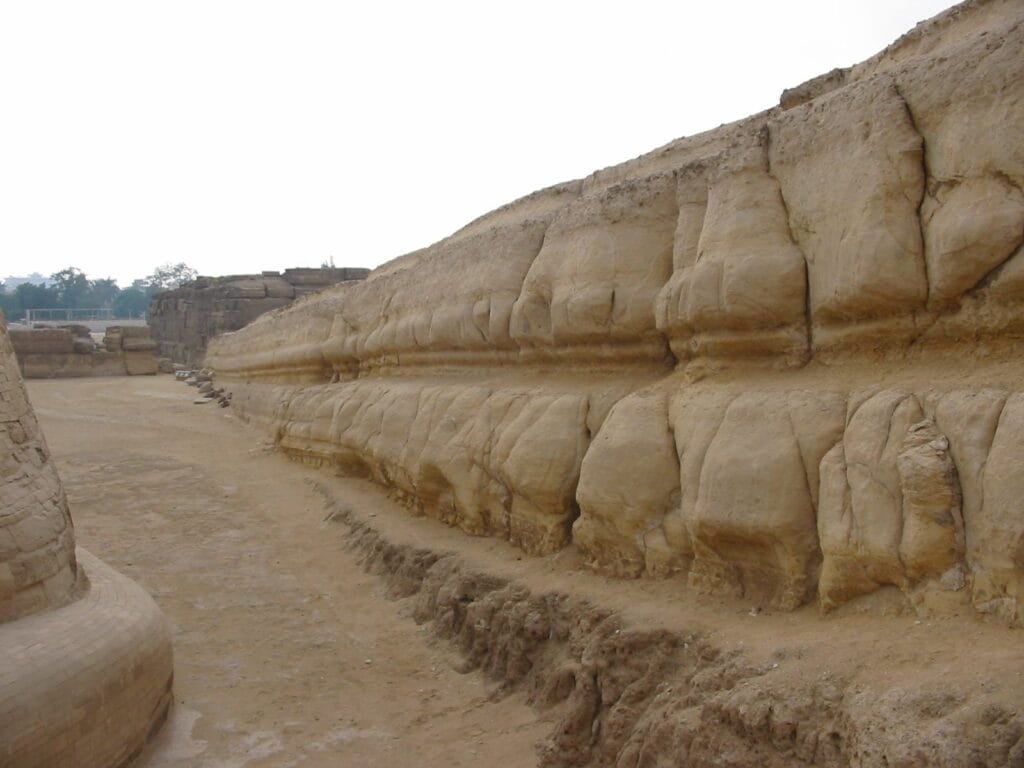
Most archaeologists believe Pharaoh Khafre built the Great Sphinx around 2500 BCE. But that timeline collapses under closer inspection. Look at the statue’s body, and you’ll see deep, rounded erosion channels, signs of sustained rainfall, not desert weather.
Here’s the problem: Rain hasn’t fallen on the Giza Plateau for over 9,000 years.
So the question stands:
How old is the Sphinx, really?
If rain shaped its body, then someone carved the Sphinx thousands of years before ancient Egypt even existed. That pushes its origin back into a forgotten chapter of human history.
🧱 Cracks in the Official Story
Mainstream Egyptologists claim the Sphinx was built under Pharaoh Khafre’s reign during the Fourth Dynasty. They suggest it functioned as a symbol of royal authority aligned with the pyramids.
However, this theory only works if we ignore what the stone actually reveals. The limestone tells a different story, one that stretches far beyond dynasties and into an era untouched by modern archaeology.
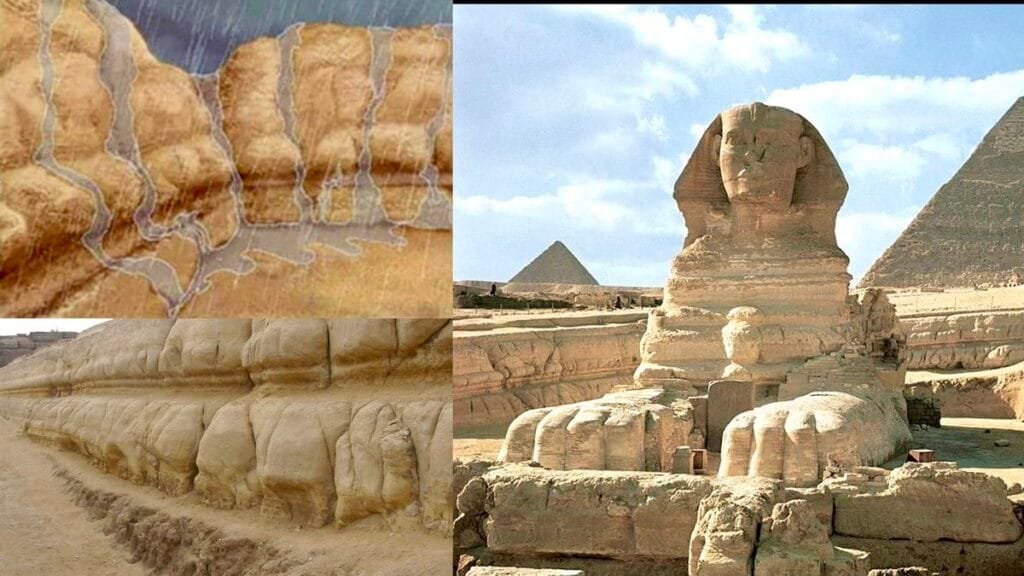
Clearly, the Sphinx isn’t just old.
It’s ancient in a way that forces us to rethink the timeline of civilization itself.
🧪 Robert Schoch and the Discovery That Changed Everything
In the early 1990s, geologist Robert Schoch visited the Sphinx enclosure. What he noticed contradicted everything Egyptologists had assumed for decades. The walls didn’t show damage from sand or wind. Instead, vertical erosion channels ran down the surface, forming smooth, flowing patterns.
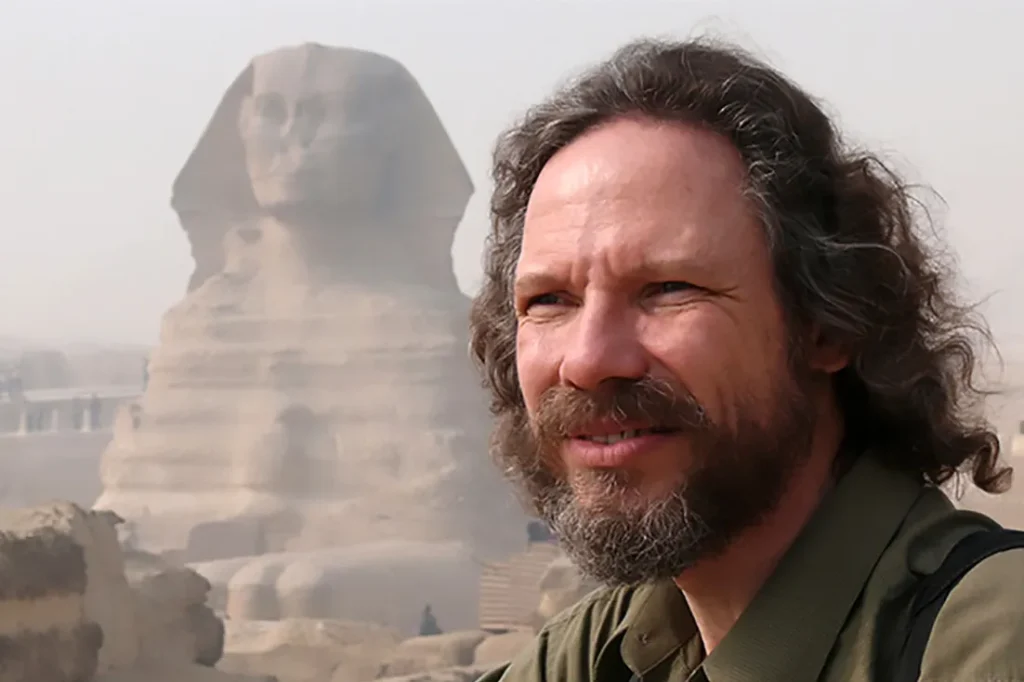
Geologists don’t consider this unusual. In fact, this erosion tells a clear story: it came from centuries of heavy rainfall.
Wind and sand alone can’t create that kind of erosion.
🌧 Rainfall in a Desert?
Egypt hasn’t experienced rainfall of that magnitude since 7000 to 10,000 BCE. That timeline stretches thousands of years before any pyramids appeared on the horizon.
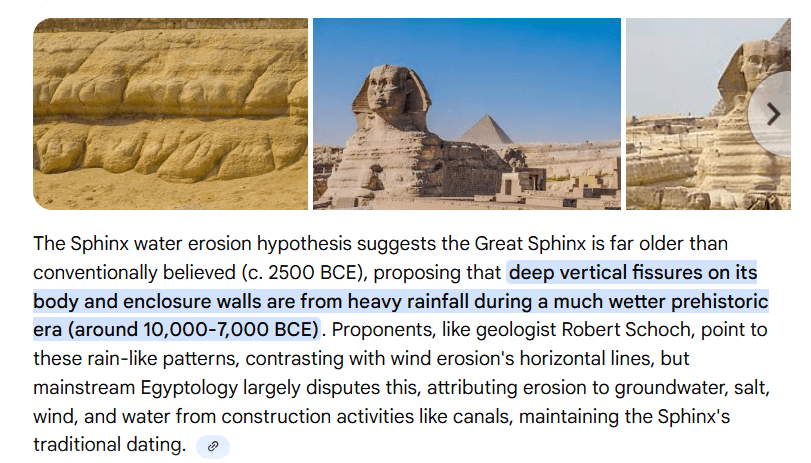
This means one thing: The Sphinx’s body may have been carved during a time when Egypt was still a savanna.
If that’s true, then the Sphinx doesn’t just predate Egyptian civilization, it could belong to a completely forgotten culture. One capable of large-scale engineering long before written language or centralized governments existed.
🧠 Ancient Civilizations Before Egypt?
Modern historians insist that humans during this time lived in small, scattered communities. According to mainstream timelines, early humans had only just begun farming and domesticating animals.
Yet someone, possibly an unknown civilization, designed and carved the largest monolithic statue on Earth. They understood limestone. They organized massive labor forces. They completed an engineering feat that still puzzles scientists today.
And they did all of this before the Sahara became a desert.
🧩 The Sphinx Water Erosion Theory: Evidence Egyptology Ignores
Egyptologists argue that the erosion came from desert wind or moisture trapped in the enclosure. But that explanation falls apart under scrutiny.
The temples next to the Sphinx, cut from the same type of limestone and exposed to the same desert climate, don’t show similar erosion. If wind had caused the damage, then those structures should exhibit identical wear.
They don’t.
That makes the Sphinx an anomaly, unless it weathered through a completely different climate.
One far older than the Egyptian civilization we credit for its construction.
🗿 Why the Head Doesn’t Match the Body
Another major clue lies in the Sphinx’s proportions. The head looks too small for the massive body. Even worse, it’s better preserved, almost untouched, compared to the heavily eroded torso.
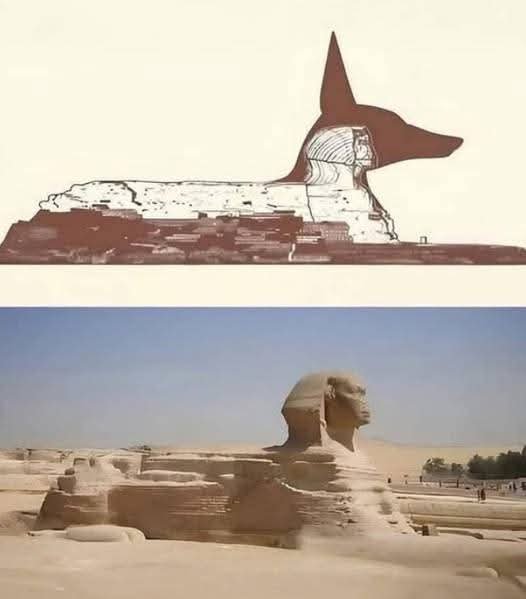
Experts on both sides of the debate agree: the head doesn’t fit.
So why the mismatch?
Because it was probably recarved. Imagine a statue so ancient that its original face wore away. Then, centuries later, a new civilization reshaped that face to resemble a pharaoh. That would explain the size difference and the preservation gap.
Now the Sphinx looks like two timelines fused into one: a prehistoric body and a dynastic makeover.
❓ So… How Old Is the Sphinx?
Let’s connect the evidence:
- The erosion fits rainfall, not wind.
- Egypt hasn’t seen rainfall like that since 10,000 BCE.
- The surrounding temples don’t show similar damage.
- The head doesn’t match the body in age or scale.
All signs point to this: The Sphinx is far older than the pyramids. It may come from an unknown civilization that predates ancient Egypt by thousands of years.
That raises a deeper mystery:
Who built the Sphinx—and why did they vanish without a trace?
🔥 The Stone Doesn’t Lie
Debates will continue. Scholars will argue. But the stone won’t change its story.
Until we ask the right questions, the Sphinx will keep watching us from across the desert. It will remain silent, holding the rain-carved truth we still refuse to face.
Maybe it’s not just a monument.
Maybe it’s a survivor from a forgotten world.